Home Textile Print Design with AI: Bedsheet Workflow Guide
Home textile print design is the work of developing repeat patterns, borders and colourways for bedsheets, curtains, cushions and table linen, then preparing them as production-ready files for rotary or digital printing. The fastest workflow available to mills today uses AI for the mechanical stages: motif generation, seamless repeats, border extension, colourway ranges and print-ready resolution. Designers keep the judgment calls: layout, colour on fabric and what actually suits the buyer. This guide walks that workflow end to end with a single-bed sheet as the worked example, and anchors the design brief in the Heimtextil 27/28 trend directions that home textile buyers will quote through 2027.
Why home textiles deserve their own print design workflow
Most AI design guidance is written for fashion yardage, but home textiles behave differently on the drawing table and on the machine. Repeats are larger, fabric widths run up to 3.2 metres, borders and panel layouts matter as much as the all-over field, and a design that wins is reprinted for seasons rather than weeks. The commercial stakes are also rising again. The global digital textile printing market is forecast to grow from USD 3.09 billion in 2026 to USD 4.28 billion by 2031, a 6.73 percent CAGR, with pigment inks the fastest-growing ink type at 7.74 percent; pigment matters for bedding because it prints cotton, polyester and blends without pre-treatment. For Indian mills the home textile story runs through Panipat, whose home textile and handicraft exports are worth around Rs 20,000 crore a year, with about 60 percent going to the US. That trade spent 2025 under a 50 percent US tariff before the interim trade deal announced on 2 February 2026 brought the reciprocal rate down to 18 percent. Orders are moving again, margins are not what they were, and the mills that win reorders are the ones that can turn a trend brief into approved artwork in days rather than weeks.
Indian exporters are also showing up to sell design, not just metreage: 546 Indian exhibitors registered for Heimtextil 2026, keeping India among the fair's top five exhibitor nations across bed, bath and living, decorative fabrics and rugs. A faster design workflow is how a job-work house in Panipat or Ahmedabad competes with a studio in Como.
The Heimtextil 27/28 brief: what buyers will ask for
Messe Frankfurt previews its trend programme a season ahead, and the Heimtextil Trends 27/28 programme, curated with the Milan design platform Alcova and shown at the fair from 12 to 15 January 2027, is titled Home-Maxxing. It names three directions, and each one translates directly into print decisions:
- Staged Competence. Technical performance worn openly: codes, numbers, symbols and micrographics used as decoration. Colours run to cool blues and greens, mineral shades and pale, almost synthetic tones with a bright acid yellow accent. For print, think fine geometric fields, grid textures and small technical motifs that need crisp separation.
- Inside, Out. Construction made visible: seams, straps, zips and fastenings treated as design features, in dark charcoal and graphite with a saturated red, soft violet and muted green-grey. For print, linear motifs and exposed-structure graphics that reward a clean outline screen.
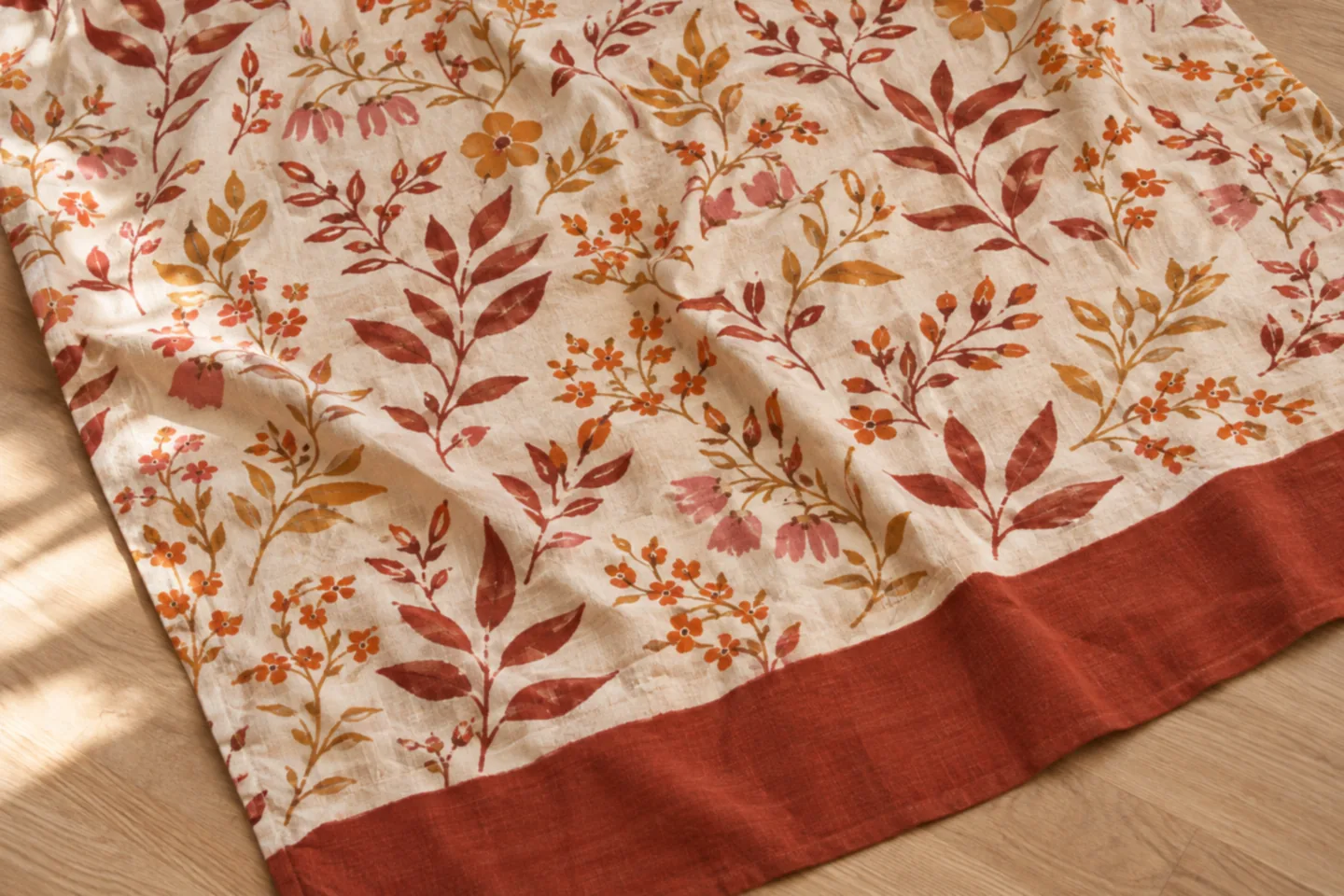
- Hyper Presence. The tactile counter-movement: natural fibres, rich texture and patina, in deep rust, burnt orange, ochre, dusty pink and warm off-white. This is the direction most naturally suited to printed bedding, and it is the palette the worked example below uses.
Note
There is a practical reason to take the 27/28 brief seriously now rather than next summer. Home textile buying cycles are long: ranges shown at Frankfurt in January are sampled through spring and shipped for the following autumn, so artwork developed this quarter is what sits in those meetings. A studio that waits for the trend to be visible in the market is designing for a season that has already been bought.
Rotary or digital: decide before you design
Home textile print design starts with a production decision, because the two routes put different constraints on the file. Rotary screen printing ties your repeat height to the circumference of the screens your printer stocks and gives you one engraved screen per colour. Machines such as SPGPrints' Palm run repeats of 640, 725, 819, 914 or 1018 mm, print widths up to 2,250 mm, up to 16 colour stations and speeds up to 80 metres per minute, which is why rotary still owns long bedsheet runs. Digital removes the repeat and colour-count constraints entirely and goes wider: dedicated home furnishing machines such as ColorJet's FabJet Grand print up to 3,200 mm wide with reactive, disperse, pigment or acid inks. Our digital vs rotary comparison covers the economics in depth; the short version for bedding is below.
| Rotary screen | Wide-format digital | |
|---|---|---|
| Repeat height | Fixed: 640, 725, 819, 914 or 1018 mm screens | Any repeat, or none (engineered panels) |
| Colours | One screen per colour, up to 16 stations | No practical limit |
| Width | Up to 2,250 mm on machines like the Palm | Up to 3,200 mm on home furnishing machines |
| Speed | Up to 80 m/min | Tens of linear metres per hour, mode dependent |
| Economics | Engraving cost up front, cheapest per metre on long runs | No screens, wins on samples and short runs |
| File you need | Colour-reduced tile plus one separation per colour | Full-colour tile at target DPI at final size |
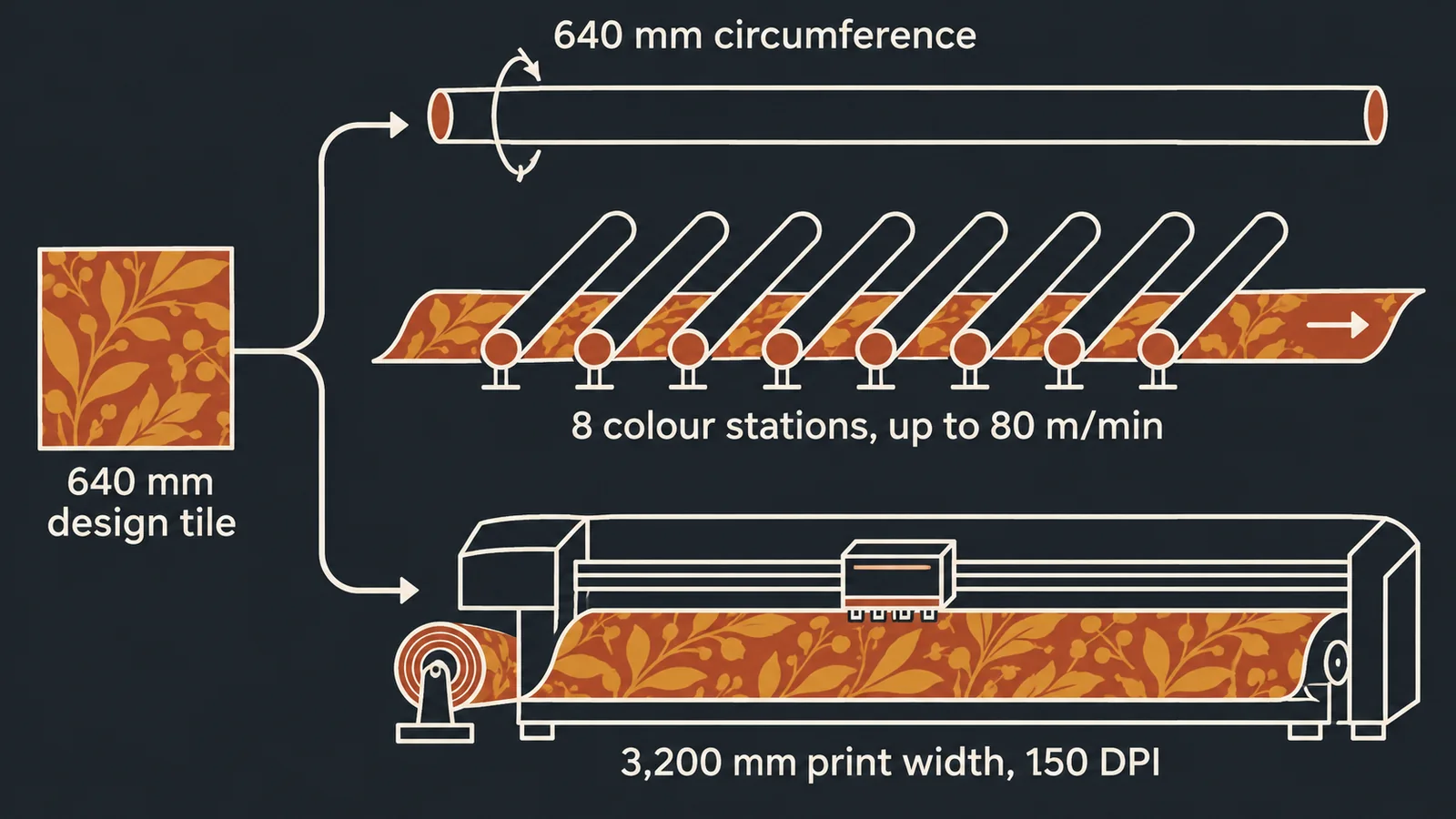
The practical answer for most Indian bedsheet programmes is both: sample and sell digitally, then move winners to rotary for bulk. That is why the workflow below builds one 640 mm tile that serves both routes, samples 100 metres digitally, and only then pays for screens for a 5,000 metre rotary run.
The AI workflow: one bedsheet from trend brief to press
Pick the sheet architecture before anything is drawn
A bedsheet is not yardage. Before any motif exists, decide how the design sits on the made sheet, because every later file decision follows from it. An all-over layout is one repeat tile flooding the full width, the cheapest to engrave and the most forgiving in cutting and stitching, which is why it dominates job-work bedsheet programmes. A bordered layout adds a band along one or both edges, reads as a richer product on the shelf and costs you extra screens or an engineered digital file. A full panel layout composes the whole sheet as one placed design; on rotary that is rarely economic, so panels usually mean digital. The worked example takes the middle path that most Indian retail bedsheet ranges use: an all-over field plus a border band, built from the same motif family so the sheet reads as one design rather than two stitched together.
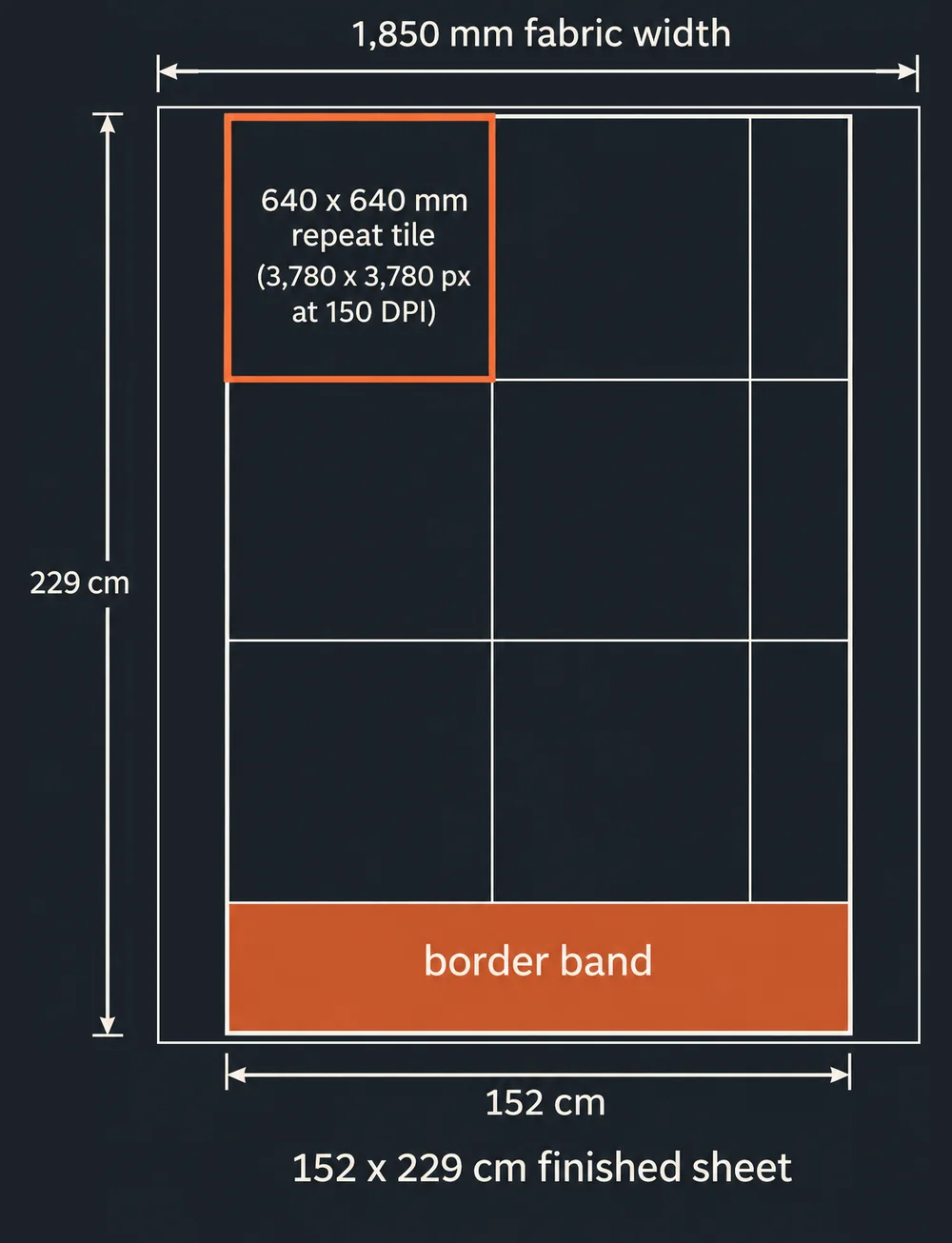
The worked example is a single-bed sheet, finished size 152 x 229 cm, printed on 1,850 mm sheeting: an all-over botanical field in the Hyper Presence palette with a deeper border band along one edge. Here is the specification the whole workflow targets.
Worked example at a glance
- Finished sheet 152 x 229 cm on 1,850 mm wide sheeting
- All-over repeat tile 640 x 640 mm, matching the smallest standard rotary screen
- File size 3,780 x 3,780 px at 150 DPI at final size
- Colour-reduced to 8 colours for rotary separation
- 12 colourway options generated, 3 shortlisted for lab dips
- 100 m digital trial, then a 5,000 m rotary bulk run
Generate motifs against the trend brief
Collect reference images for the direction you are designing into, then use Design Generation to produce variations from a reference image with a custom palette of up to 10 hex colours, no text prompts needed. For the worked example that palette is rust, burnt orange, ochre, dusty pink and warm off-white. Generate in batches, shortlist the way you would shortlist a junior designer's sheets, and keep only motifs that will survive colour reduction to 8 colours.
Build the 640 mm repeat
Feed the shortlisted motifs to Motif Arrangement, which places up to 20 motifs into block, half-drop, radial or scatter layouts with spacing, rotation and scale variation, and exports a seamless tile. If you are starting from one complete design instead of loose motifs, Repeat Set builds block, half-drop, half-brick or step repeats with a grid preview. Neither tool takes a size in millimetres: physical repeat size is set by pixel dimensions and DPI at export, so a 640 x 640 mm tile at 150 DPI is 3,780 x 3,780 px. Our seamless repeat guide covers choosing between repeat types.
Extend the artwork for the border band
Bedsheets sell on the border as much as the field. Design Extension expands a motif or partial pattern toward a set target dimension while keeping the style, palette and texture of the original, which is exactly the job of growing a border band that belongs to the same design family as the all-over field. Keep the border artwork in the same 8-colour world as the field so both can print in one rotary pass.
Build the colourway range before sampling
Buyers decide between colourways, not single designs. Colourways recolours the approved tile into 6 to 48 options in one run without redrawing the artwork; pin the warm off-white ground so every option keeps it, and generate 12 options with a buyer sheet. Shortlist 3 for lab dips. Colour on screen is a reference, not a promise: judge final colour on fabric against your physical references, the way you would judge any lab dip.
Separate for rotary
Once the digital trial sells, prepare the rotary file. Color Separation outputs editable PSD layers, one layer per colour, so the 8-colour tile becomes 8 separations your engraver can take to screens. Check each layer at 100 percent for pinholes and broken lines before it leaves the studio; engraving reworks cost more than studio time.
Deliver print-ready resolution
The digital route needs the tile at final size and DPI. If your approved artwork is smaller than 3,780 x 3,780 px, use Super Scaler for upscaling with detail recovery, or Ready to Print for a one-click 2x, 3x or 4x upscale to a target DPI. Upscale the approved file rather than regenerating it, so what prints is what was approved. Our guide to print-ready upscaling covers DPI targets by print method.
Where AI falls short in home textile print design
Honest limits, from production floors rather than demos. AI does not know your machine: it will happily build a 700 mm repeat no screen in your stock can print, so the 640, 725, 819, 914 and 1018 mm constraint has to come from you at the start. It cannot judge colour on fabric: pigment on a cotton-rich sheeting and reactive on the same base behave differently, and a 150 DPI file that looks perfect on screen still needs a strike-off and lab dips before anyone commits 5,000 metres. Sheet-level composition is still a designer's job: the balance of field to border, the weight of the design on a made-up bed and whether a scatter reads as relaxed or messy are judgments no creativity slider makes. And trend adoption is a merchandising decision; Heimtextil directions tell you where buyers are looking, not what your market in Jaipur or your buyer in Hamburg will actually reorder. Use AI where the problem is mechanical: generation, repeats, extension, colourways, separations and upscaling. Keep the judgment human.
Frequently asked questions
What repeat size should I use for a bedsheet design printed on rotary machines?
Match the screen circumferences your printer actually stocks. Standard rotary repeats are 640, 725, 819, 914 and 1018 mm, so a 640 x 640 mm tile is the safest starting point for an all-over bedsheet design. Your design height must divide evenly into the screen circumference, otherwise the engraver will ask for a rework.
What DPI do I need for digital bedsheet printing at wide widths?
Most wide-format home textile work prints well at 150 DPI at final size, because bedding is viewed at arm's length rather than close up. At 150 DPI, a 640 x 640 mm repeat tile is 3,780 x 3,780 px. If your buyer or printer asks for more, upscale the finished tile rather than regenerating it, so the approved artwork does not change.
How many colours can a rotary-printed bedsheet design have?
Each colour needs its own engraved screen, and machines such as SPGPrints' Palm run up to 16 colour stations. In practice most bedsheet jobs are separated to 6 to 10 colours to keep engraving and strike-off costs sensible. The worked example in this guide reduces an AI-generated design to 8 colours before separation.
Can AI design a complete bedsheet with border and all-over layout on its own?
Not reliably. AI is strong at generating motifs, building seamless repeats, extending artwork toward a border and producing colourway ranges. The overall sheet composition, the balance between field and border, and the final colour decisions on fabric still need a designer and a lab dip. Treat AI as a fast assistant for the mechanical stages, not a replacement for design judgment.
What are the Heimtextil 27/28 trend directions for home textile prints?
Messe Frankfurt's Trends 27/28 programme, curated with the Milan design platform Alcova, is titled Home-Maxxing and names three directions: Staged Competence (technical codes and micrographics as decoration, cool blues and mineral tones with an acid yellow accent), Inside, Out (visible construction, charcoal and graphite with saturated red and soft violet) and Hyper Presence (tactile natural surfaces in rust, ochre, dusty pink and warm off-white). They are presented at Heimtextil, 12 to 15 January 2027 in Frankfurt.
The brief for 2027 home textiles is already public: warmer, more tactile, more honest surfaces, with buyers walking Frankfurt in January expecting mills to have read it. A mill that turns that brief into a sampled, colourway-ranged, separation-ready bedsheet design in a week, not a month, is the mill that gets the programme. That is the workflow the tools above are built for.